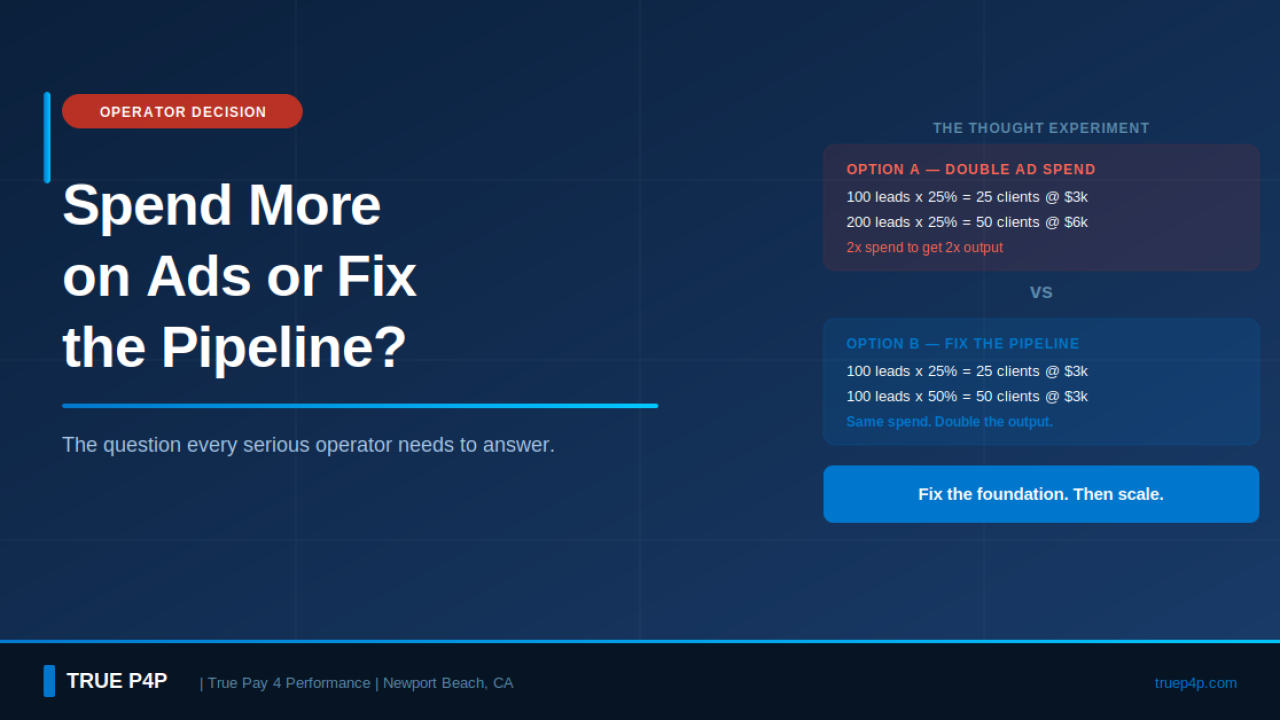

Before you approve the next increase to your ad budget, run this thought experiment. It takes 60 seconds and it might change how you think about growth entirely.
You’re spending $3,000 a month on lead generation. Your current system converts 25% of inbound leads. You’re closing 25 clients from 100 leads. You want more. The obvious move — the one most operators make — is to double the ad spend. Double the leads. Double the clients. Here’s why that math is more expensive than it looks.

Option A: Double the Ad Spend
Budget goes from $3,000 to $6,000. Lead volume doubles to 200. At the same 25% conversion rate, you close 50 clients. Revenue doubles. Sounds great.
Except — you’ve doubled your acquisition cost. You’re now spending $6,000 to get 50 clients — $120 per client. And the broken system that loses 75% of your leads is still there. It’s just processing more volume now. You’re losing 150 leads a month instead of 75. The leak got more expensive, not smaller.
Option B: Fix the Pipeline
Keep the same $3,000 budget. Same 100 leads. But fix the conversion system — instant response, consistent follow-up, proper qualification, automated re-engagement. Conversion moves from 25% to 50%.
Now you’re closing 50 clients on the same 100 leads at the same $3,000 spend. Cost per acquisition drops from $120 to $60. Same number of new clients. Half the spend. And $3,000 sitting ready to deploy into acquisition once the foundation is proven.
Same spend. Double the output.
And the foundation is now strong enough to actually scale.
Why Most Operators Choose Option A Anyway
Increasing spend feels like action. It’s visible, immediate, and easy to explain. “We doubled our marketing budget” sounds like a growth strategy. “We fixed our conversion infrastructure” sounds like maintenance.
But increasing spend on a broken system doesn’t fix the system — it amplifies it. If your pipeline loses 75% of leads at $3k/month, it will lose 75% at $6k/month. You’ve just scaled the waste.
The most expensive marketing strategy
Spending more money on a system that doesn’t convert. Every dollar you put into acquisition on top of a broken pipeline is partially wasted before it has a chance to work. The agencies selling you more ad spend without auditing your conversion rate first are not acting in your interest.
What Fixing the Foundation Actually Means
Response Time
If leads wait hours for a response, a significant percentage have already moved on. Automating an instant first response can move the needle on conversion immediately — without changing a single ad.
Follow-Up Consistency
Most deals need 5 to 12 touchpoints. If your team makes 2 attempts and moves on, you’re leaving most of your pipeline on the table. Automated multi-touch sequences close the gap without adding manual effort.
Pipeline Visibility
You can’t fix what you can’t see. Real-time pipeline tracking shows exactly where leads are dying — so you can address the specific stage costing you the most conversion, not just guess.
Cold Lead Re-Engagement
The leads that went quiet last month are still qualified. Automated re-engagement sequences recover revenue most businesses have written off — at zero additional ad spend.

Share this on LinkedIn →
When to Scale the Spend
We’re not anti-advertising. Paid acquisition is one of the most powerful growth levers available. But it’s a multiplier — and multipliers amplify what’s already there. Multiply a working system and you get accelerated growth. Multiply a broken system and you get accelerated waste.
The right time to increase ad spend is after you can prove your conversion rate is optimized. When you know every dollar in produces a predictable number of dollars out — then scale. But not before.
KEY TAKEAWAY
Going from 25% to 50% conversion on your existing leads costs less and produces more than doubling your ad spend. Fix the foundation. Then scale. In that order, always.
Find out what your current conversion rate is actually costing you.