
Most businesses think of reputation management as damage control — responding to a bad review, encouraging a happy client to leave feedback, keeping the rating above four stars. But that framing misses the most important insight in local search and buyer psychology:
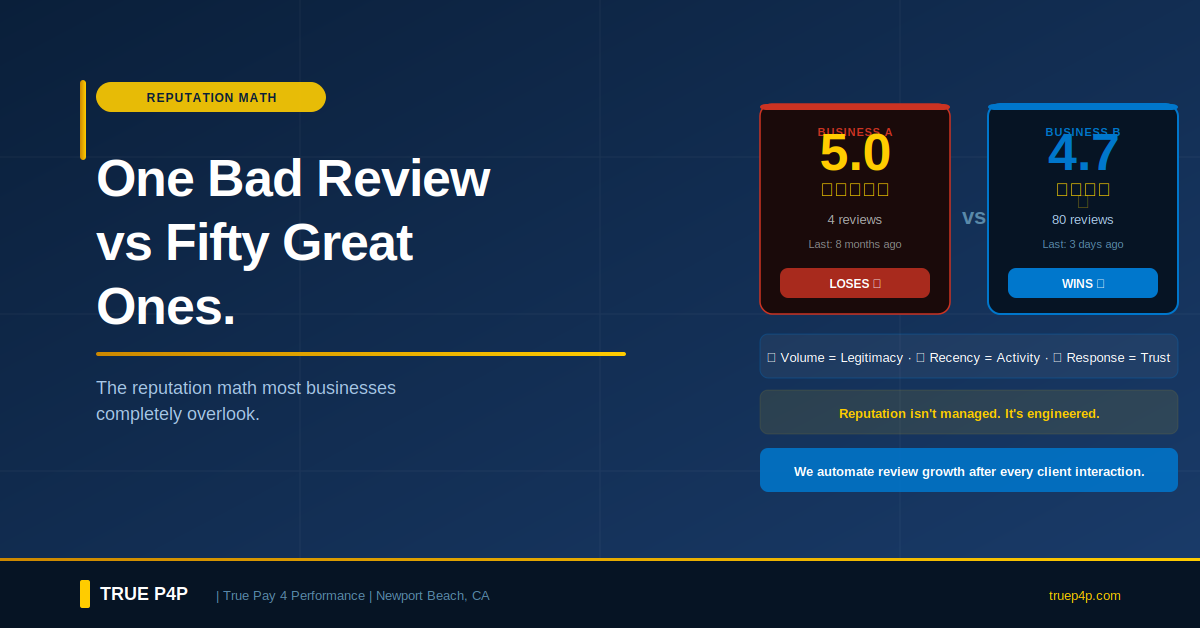
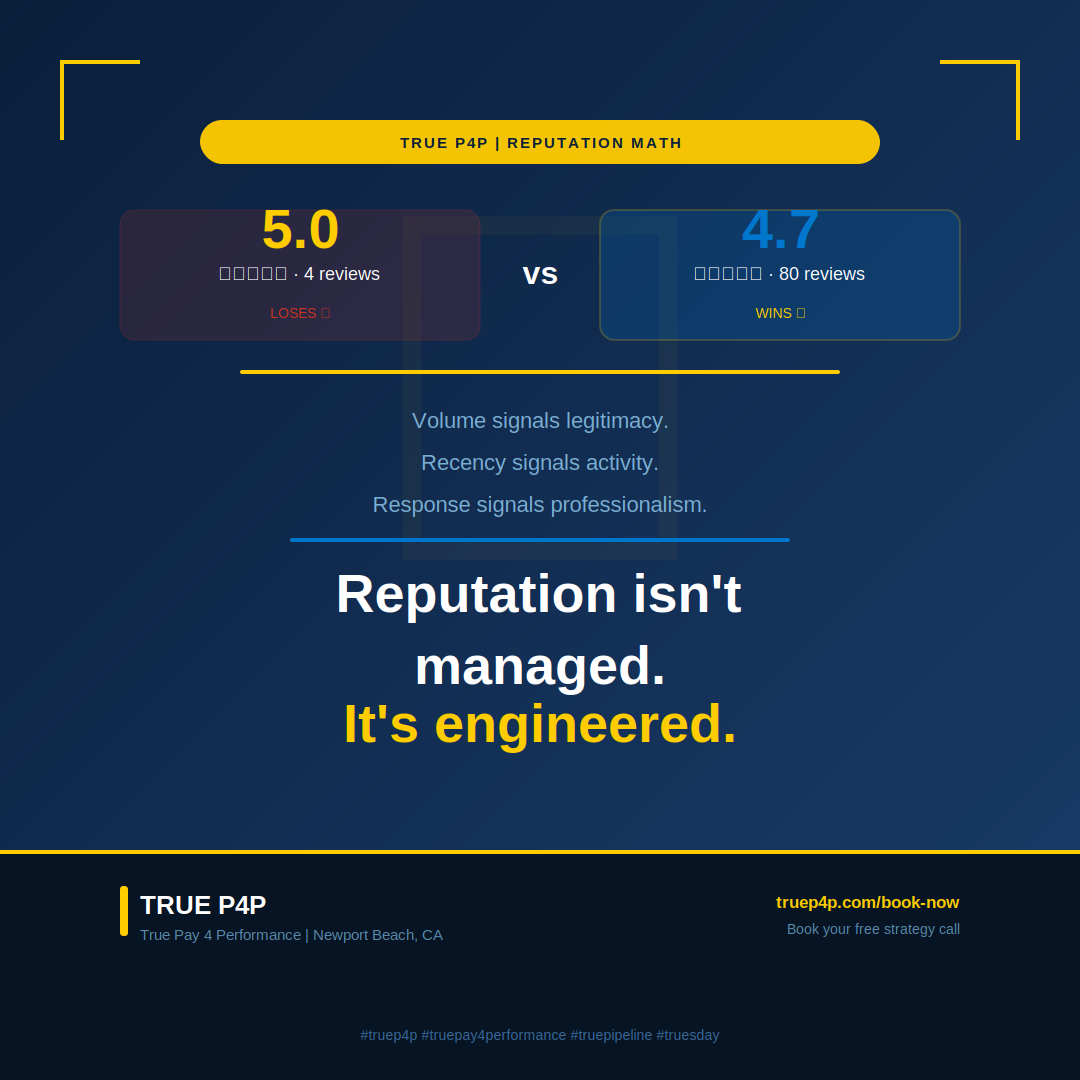
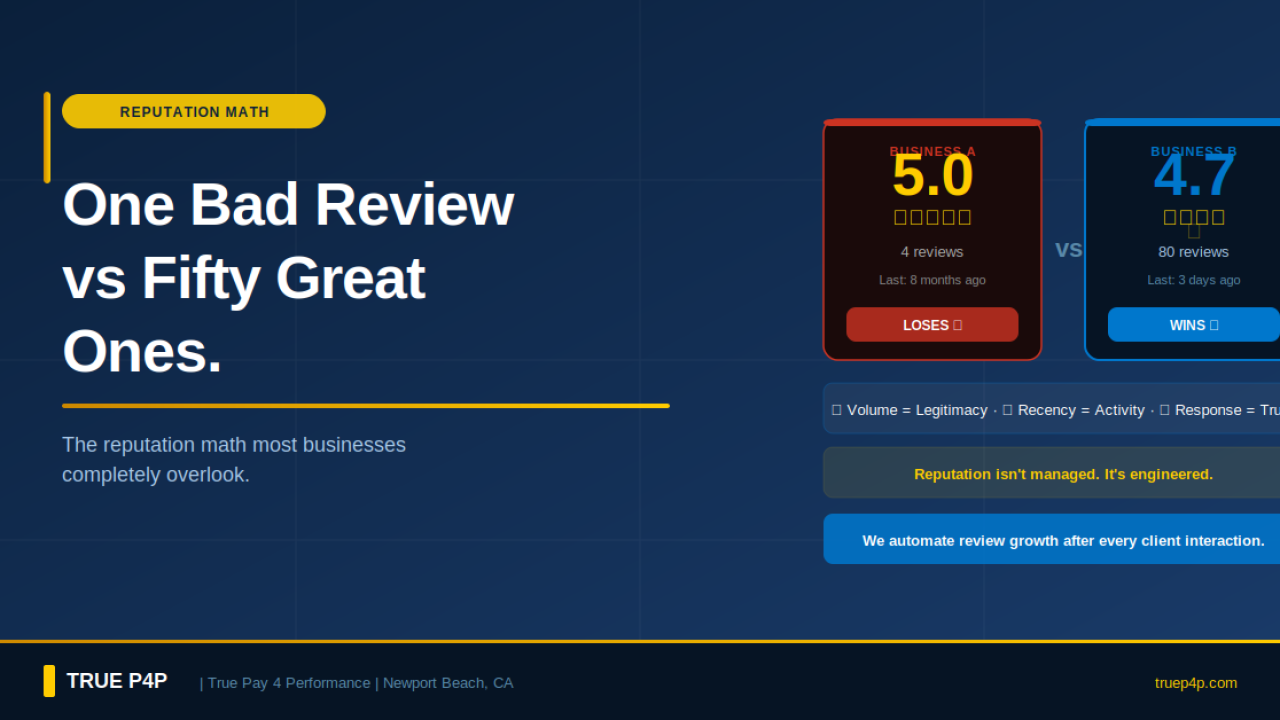
A business with four reviews and a perfect 5.0 rating almost always loses to a competitor with 80 reviews and a 4.7 rating. Every single time. On Google, on the decision-making process of a new prospect, and in the conversion numbers that follow.
If you don’t understand why — and most businesses don’t — you’re making a decision about your reputation management strategy based on faulty assumptions. This post corrects that.

The Three Signals That Actually Drive Reputation
When a prospect in Newport Beach pulls up two competing businesses on Google, they’re not running a spreadsheet comparison. They’re reading signals. Their brain makes a rapid assessment — within seconds — based on three factors that operate almost entirely subconsciously:
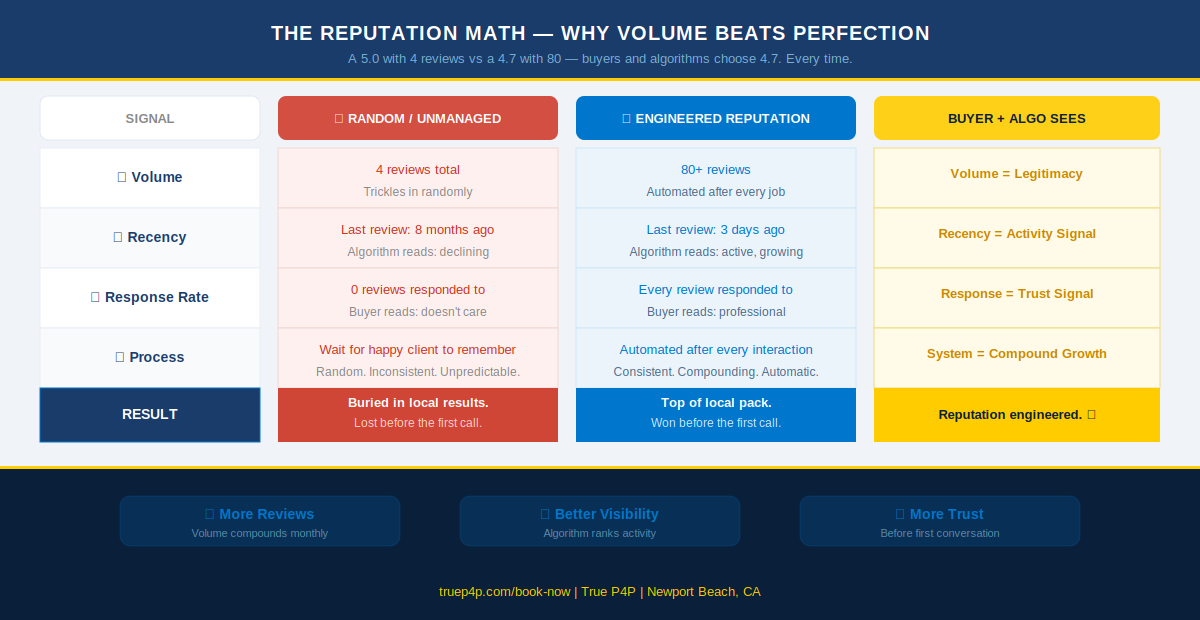
Volume Signals Legitimacy
A business with 80 reviews has had 80 clients motivated enough to take time out of their day to write something down. That’s social proof at scale. A business with four reviews might be better — but the prospect can’t know that. They can only read what’s in front of them. And four reviews reads as: small, new, or not popular. Even if none of those things are true.
Recency Signals Activity
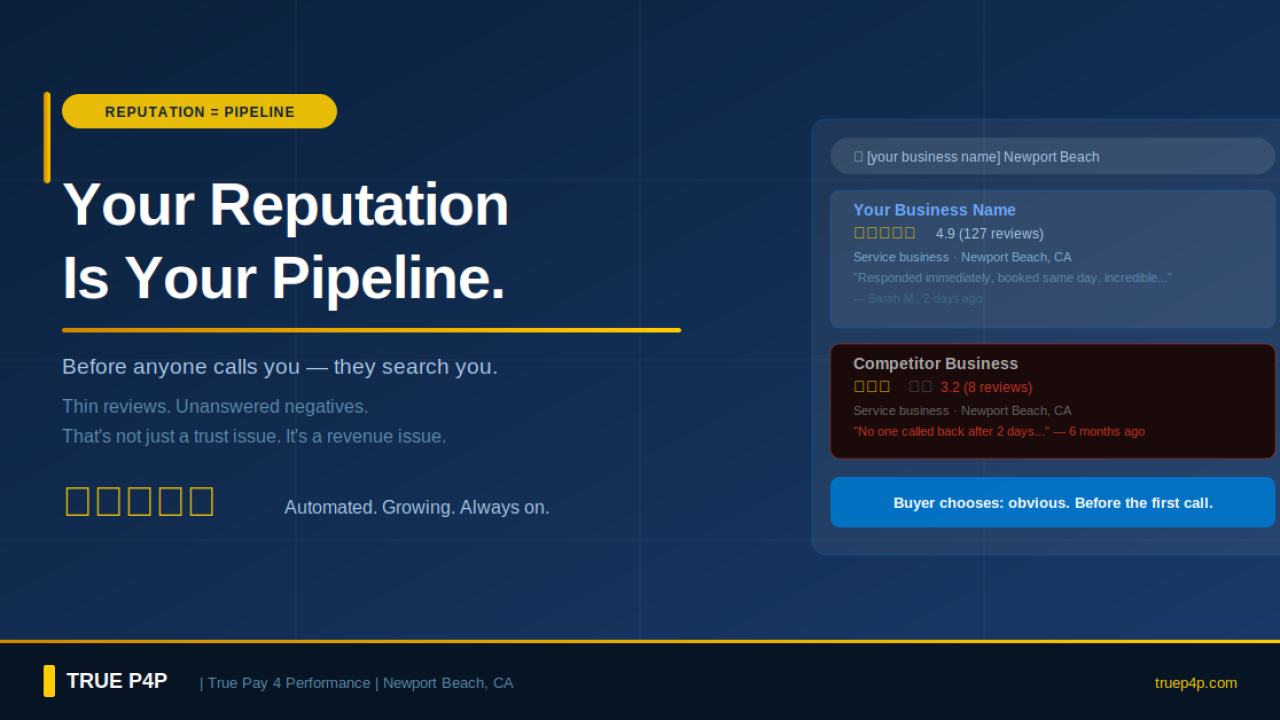
The date on the most recent review is one of the first things a prospect’s eye goes to. “Last review: 3 days ago” signals a business that’s active, growing, and still serving clients. “Last review: 8 months ago” plants a seed of doubt. Are they still open? Are they still good? Did something change? That doubt rarely gets resolved in your favor — the prospect moves on before asking.
Response Rate Signals Professionalism
When a prospect reads a negative review and then reads a thoughtful, professional response from the business owner — their confidence in the business often increases. It shows accountability, care, and communication. When a negative review sits unanswered, the prospect reads the worst interpretation into the silence. How a business responds to its critics is a preview of how it treats its clients.
Why Most Businesses Collect Reviews Randomly
The default review collection strategy for most service businesses goes something like this: when a client gives exceptional feedback — in person, in a follow-up email, in casual conversation — someone on the team says “hey, would you mind leaving us a Google review?” Sometimes the client does. More often, they mean to and forget.
The result is a review profile that’s entirely dependent on timing and memory. Happy clients who got amazing results but were never asked: no review. Happy clients who were asked at the wrong moment — when they were rushing to a meeting, or distracted: no review. The business’s online reputation reflects a random sample of its actual client experience, not the full picture.
The compounding problem of random collection
The clients most likely to remember to leave a review unprompted are the ones with the strongest reactions — either very happy or very unhappy. When you rely on organic, unprompted reviews, you’re sampling from the extremes. The satisfied client who had a good but not exceptional experience — who represents the majority of your clients — almost never leaves a review unless they’re specifically asked. Random collection means your profile is disproportionately shaped by outliers.
What Engineered Reputation Looks Like
We automate the review request process immediately after successful client interactions. Not occasionally. Not when someone remembers. After every interaction that meets a defined completion threshold — a job delivered, an appointment completed, a project closed — a review request goes out automatically.
The timing is calibrated for maximum response rate. The message is personalized without requiring manual effort. And the request goes to Google — not to a proprietary platform that doesn’t affect your search ranking.
✓
More Reviews
Every client asked. Volume grows consistently. Profile looks active every week.
📈
Better Visibility
Google rewards recency and volume. Local ranking improves. More prospects find you first.
🏆
More Trust
Before the first conversation, the prospect is already confident. Social proof does the pre-selling.

Share this on LinkedIn →
Reputation Compounds — But Only If You Build the System
The businesses dominating local search in Newport Beach and Orange County got there because they started the compounding process earlier. Twelve months of automated review collection, consistent responses, and profile activity creates a gap that’s genuinely hard to close — not because the competitor is better, but because they built the system first.
The best time to start was six months ago. The second best time is today.
KEY TAKEAWAY
A 5.0 with 4 reviews loses to a 4.7 with 80 — every time. Volume, recency, and response rate are what Google and buyers actually measure. Reputation isn’t managed. It’s engineered. And the engineering starts with automating review requests after every client interaction.
Find out what your current reputation profile is costing you in local search.